Q&A With Puerto Rico FC President Tom Payne
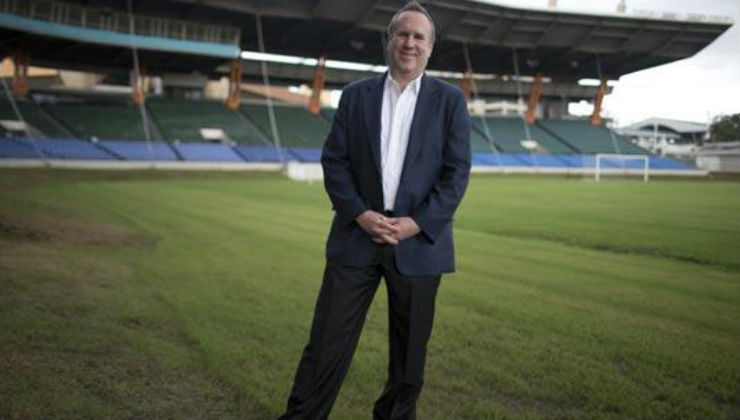
Tom Payne, a native of Peekskill, N.Y., is no stranger to star power, having spent five years as the Los Angeles Galaxy’s president of business operations while living in the soccer vortex surrounding the English star David Beckham during his time in MLS. He was selected by Carmelo Anthony as PRFC’s first president, charged with overseeing every aspect – from corporate partnerships to communications – of the NASL expansion club’s front office. Payne, the brother of the former D.C. United executive Kevin Payne, spoke with Jack Bell of NASL.com.
Bell: You landed your new job in early November. So how’s it been going?
Payne: Things are good. We’ve got a lot going on, though we’re not really staffed yet. Pretty soon we’ll have some real meaningful announcements.
Bell: Do you have a timeline?
Payne: We’ll announce our first couple of players, then start rolling out more announcements regularly. With our situation starting in the summer [at the start of the NASL’s Fall Season] we will have to leave space on the roster for some late signings. By mid-March we’ll probably have a third to half of what would be our final roster, maybe half of them will be internationals. By mid-May we’ll have the entire group together.
Bell: How did you end up making the move from one of the most recognizable names in North American club soccer to one of the newest teams around?
Payne: I left the Galaxy in 2012, doing some kind of consulting work, most of it in soccer. I did a project for the Rose Bowl. I helped a USL team as a consultant. It really allowed me to have some flexibility because when I moved to LA my son stayed behind in Orlando with his mom. I flew back and forth because it was important to me to see his college games. I also had some interesting proposals in other countries, mostly because I’ve done so much work around the world with the Galaxy at the height of the Beckham thing, especially in places like Australia and New Zealand.
Since I left the Galaxy I’ve said several times on the record that my real interest is in building an organization and a team from scratch. Then this came along. I was first contacted and some people asked if I would be interested. I went to New York in late September/early October and met with Carmelo and was really impressed with him. A lot of celebrities usually have a lot of people around them, but he didn’t. It was just the two of us for 90 minutes. I was impressed with his vision of what the club can be. He’s really on a level beyond the sport trying to lift the pride on the island. There are some tough economic times and Carmelo has done a lot through his foundation and on his trips to Puerto Rico.
On a personal level, it sounds funny, but I’ll get to be a lot closer to my family than I was in LA. My entire family is on the East Coast. Professionally for me, the thing is this is a rare team, and a rare opportunity at this level. This club can actually be a meaningful member of the community on the island. On top of that, it has the opportunity to be a meaningful brand outside the island. More than five million people on the East Coast identify as Puerto Rican and more than a million in New York City alone. At all points, we’re going to bring something to the table for people from Puerto Rico living in those area. It will be another thing for them to identify with and claim as their own.
Bell: Give me an idea of how involved Carmelo Anthony is now and will be once the team gets rolling.
Payne: He is pretty involved. We talk via email and on the phone. Like most people, he has certain areas of the business that he’s really involved in, for example, he’s tuned in to what the club will look like in terms of colors, etc. He also hired me for a reason: I ran one of the biggest clubs in the U.S., and one of the most recognizable in the world. People don’t think of this, but the Galaxy commanded appearance fees on par with teams like Barcelona, Manchester United, and Real Madrid. He hired me to come and run the entire thing. He’s involved. He’ll be coming down but the NBA schedule is difficult and I try not to bother him on game days. He’s been very accessible to me.
Unlike other celebrity owners I’ve dealt with, he’s very engaged. It’s what I liked from the get-go. It’s a huge deal being the owner of a professional sports team, it’s a big investment and he’s really happy with the way things have been going, but we have a lot of work to do. We arrived pretty late, and July really is just around the corner. I wish we had more time, but we don’t.
Bell: What’s the biggest challenge you face?
Payne: A big part is telling a story about what’s going on with the game here. One thing I’ve noticed since bringing the Galaxy here in 2008, 2009, and 2010 is that it’s now much more of a soccer island, where several years ago it was predominantly a baseball island. There are soccer clubs in every market. One thing they have to deal with is that there are not enough good fields. We hope to help with that. With the economy struggling and with so many people struggling we have to have an entry-level ticket price lower than we might do otherwise. It’s just about us being a good citizen. We’ll also have other programs to accommodate those who might not be able to afford tickets.
We are engaged in changing the thought process around the sport. Part of it is getting more kids playing and more youth clubs involved, helping them attract more players. To get them to believe in soccer you have to have pro teams at the top of the pyramid locally so it becomes an aspirational part to the sport. Until Puerto Rico FC came along you could play youth soccer here all you want, but there was nothing to aspire to. We plan on changing that with Carmelo involved. We will be a first-class organization and do things the right way.
I’ve had a series of good meetings with potential sponsorship partners. We’re bullish, but also realistic. A lot of teams in U.S. can get by economically on ticket sales. We’ll do OK in that respect, but that revenue will be behind what I’ve become used to. We have to make sure to do all the other things well – merchandise is one thing we can do better. With five million Puerto Ricans on the East Coast, that’s a huge opportunity for people to wear the team’s colors. In addition, we’re the only professional sports team here, so we don’t have to compete for sponsor dollars.
There’s a hunger for the game here. There are areas where we’re hoping we can help change the culture around youth soccer at every level. In California just about every club team has a professional coach. Here we’re planning to bring that along. We think better coaching and more coaching would benefit the island. We believe that it’s part of our charter to help push the local federation and the national team to a higher level. We’d would love to be at a point where we could build our team around national team players, more than a couple. There are some jewels, though.
Bell: What do you think attracted Carmelo Anthony to the NASL?
Payne: I asked him that, too. I think that like a lot of athletes at his level they are a bit uncomfortable with the MLS model. I don’t think the single-entity, salary-cap model fits with their mindset. He also likes that the NASL has an aggressive long-term vision, trying to separate itself from the other leagues. All of those things were important to him.
Bell: Lastly, why Puerto Rico?
Payne: Carmelo, above all else, is a really good person. He comes here and does a week of events, he builds basketball courts in at-risk spots on the island. He is a part of it. The NASL is in some really good markets, in some markets that are better than USL and in some cases better than MLS, for example, Miami, New York, Carolina, and Indianapolis. They are big markets and I think that was part of it, too. I’ve got to believe he’s been pitched about some small ownership stake in an MLS team, but I know he likes the NASL model better. He’s a fan and I know he watches both leagues and the international game.
